

Craps stands as one of the most exciting and social games found in casinos worldwide. Craps is a dice game where players bet on the outcomes of rolling two dice, offering dozens of betting options with varying odds and payouts. The game attracts crowds of cheering players who gather around the table to share in the excitement of each roll.
Many newcomers feel intimidated by the complex-looking table layout and the fast-paced action. However, the basic rules are simple to learn, and players can start with easy bets before exploring more advanced options. The game offers some of the best odds in the casino when players choose the right bets.
Understanding craps opens the door to one of gambling’s most thrilling experiences. From learning the table layout and basic gameplay to mastering betting strategies and online play, players can develop the skills needed to enjoy this dynamic game. Whether playing in a casino or online, craps provides endless entertainment for those who take the time to learn its ins and outs.
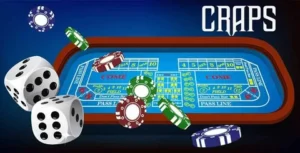
What Is Craps?
Craps is a dice game where players bet on the outcomes of rolling two dice, with the name coming from the French word “crapaud” meaning toad. The game offers more betting options than any other casino game and can be played in both formal casino settings and informal street versions.
Origins of Craps
Craps has deep historical roots that trace back to ancient dice games. The modern version developed from European gambling traditions that made their way to America.
The game’s unusual name comes from an interesting linguistic evolution. The name originated from the French word “crapaud”, which means toad or frog.
This connection happened because players would crouch down like frogs when playing the street version of the game. Over time, “crapaud” changed into “craps” through American slang and everyday use.
The game spread throughout America in the 1800s and 1900s. Street versions became popular because they needed very little equipment – just two dice and a flat surface.
Modern craps developed into two main forms:
- Street craps: Players bet against each other
- Casino craps: Players bet against the house
Basic Rules of Craps
Craps uses a pair of dice with players making bets before each roll. The game follows a specific sequence that determines wins and losses.
The game starts with a come-out roll. This first roll sets up the rest of the round and determines what happens next.
On the come-out roll, several outcomes are possible:
- 7 or 11: Pass line bets win immediately
- 2, 3, or 12: Pass line bets lose immediately
- 4, 5, 6, 8, 9, or 10: This number becomes the “point”
When a point is established, the shooter keeps rolling until they either roll the point number again (pass line wins) or roll a 7 (pass line loses).
Players can make many different types of bets during the game. Some bets resolve on a single roll, while others stay active for multiple rolls.
Object of the Game
The main goal in craps is to correctly predict the outcome of dice rolls. Players win money when their predictions match what actually happens.
Pass line betting is the most basic way to play. Players bet that the shooter will win by either rolling 7 or 11 on the come-out roll, or by making their point before rolling a 7.
Don’t pass betting works the opposite way. These players bet that the shooter will lose by rolling 2, 3, or 12 on the come-out roll, or by rolling a 7 before making their point.
The game offers dozens of other betting options:
- Field bets: Win on specific numbers in one roll
- Proposition bets: Win on exact dice combinations
- Place bets: Win when specific numbers roll before 7
Each bet type has different odds and payouts, giving players many ways to approach the game. Some bets have better odds for players, while others favor the house more strongly.
Craps Table Layout
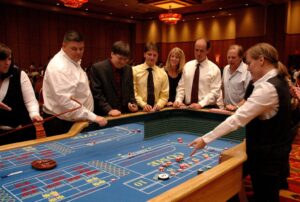
A craps table layout consists of three main sections with specific betting areas, specialized equipment including dice and chips, and multiple dealers who manage different parts of the game. The table accommodates up to 20 players and features a unique curved design that allows everyone to reach the betting areas.
Craps Table Features
The craps table measures approximately 12 feet long and 4 feet wide. It has high walls around the edges to keep dice from flying off during play.
The table divides into three distinct sections:
- Left section – Contains betting areas for players on that side
- Center section – Houses proposition bets managed by the stickman
- Right section – Mirror image of the left section for players on that side
Each end section includes the Pass Line and Don’t Pass Line, which are the most common betting areas. The Pass Line runs along the outer edge of each section.
Field bets occupy a large rectangular area in each section. This space shows numbers 2, 3, 4, 9, 10, 11, and 12.
Come and Don’t Come areas sit above the Field section. Place bet numbers (4, 5, 6, 8, 9, 10) appear in boxes across the top of each section.
The center area contains hard ways bets and one-roll proposition bets. These include snake eyes, boxcars, and any seven bets.
Dice and Equipment
Craps uses two standard six-sided dice made of cellulose or acrylic. Casinos replace dice every eight hours to prevent wear and maintain fairness.
The dice must hit the back wall of the table on every throw. Small pyramid-shaped bumpers line the walls to create random bounces.
Casino chips replace cash for all betting. Players exchange money for chips before playing. Different colored chips help dealers track each player’s bets.
A long curved stick called the dice stick allows the stickman to retrieve dice after each roll. The stick has a small notch at the end to grab the dice easily.
Betting markers show which point number is active during the game. The dealer places a white disc marked “ON” on the point number after it’s established.
Dealer Roles
Three dealers work each craps table during busy periods. Each dealer has specific responsibilities for managing the game.
The boxman sits at the center of the table and supervises the entire game. This person handles disputes, manages the chip inventory, and watches for cheating.
The stickman stands opposite the players and calls out dice results. They control the dice using the long stick and manage all center section bets. The stickman announces each roll loudly and keeps the game moving quickly.
Two base dealers stand on opposite sides of the table. They handle Pass Line bets, Place bets, and payouts for their respective sides. Base dealers also help players understand betting areas and collect losing wagers.
During slower periods, casinos may operate with just two dealers – one stickman and one base dealer.
Craps Gameplay
Craps gameplay follows a structured sequence that begins with the come-out roll and moves through distinct phases. The shooter rotates clockwise around the table, giving each player a chance to roll the dice.
Come-Out Roll
The come-out roll starts each new round of craps. Players place their bets before the shooter throws the dice for the first time.
Winning numbers on come-out:
- 7 or 11 – Pass line bets win immediately
- 2, 3, or 12 – Don’t pass bets win (12 is a push in some casinos)
If the shooter rolls 4, 5, 6, 8, 9, or 10, that number becomes the point. The dealer places a puck on the corresponding number on the table layout.
Players can make additional bets after the point is established. The basic craps rules require the shooter to continue rolling until they either make the point or roll a 7.
Point Phase
Once the point is set, the game enters the point phase. The shooter must roll the point number again before rolling a 7 to win.
Point phase outcomes:
- Rolling the point number – Pass line bets win, new come-out roll begins
- Rolling a 7 – Pass line bets lose, dice pass to next shooter
Players can take or lay odds bets during this phase. These bets pay true odds and have no house edge.
The shooter keeps rolling until they either make their point or “seven out.” Other numbers (not the point or 7) don’t end the round. Players can continue making come bets and other wagers while the point phase continues.
Shooter Rotation
The dice move clockwise around the table to the next player when the current shooter sevens out. Each player gets the opportunity to shoot when it’s their turn.
Shooter requirements:
- Must place a pass line or don’t pass bet
- Must throw dice hard enough to hit the far wall
- Both dice must stay on the table
Players can decline to shoot and pass the dice to the next person. The new shooter starts with a fresh come-out roll.
If a die leaves the table, play stops until both dice are inspected and returned. The step-by-step craps guide explains that maintaining proper dice control keeps the game moving smoothly.
Types of Craps Bets
Craps offers several fundamental bet types that form the backbone of gameplay. The Pass Line serves as the most basic wager, while Come bets function similarly but can be placed after the point is established, and Odds bets provide some of the lowest house edges available.
Pass Line and Don’t Pass Bets
The Pass Line bet is the most popular wager in craps and offers excellent odds for beginners. Players place this bet before the come-out roll.
Pass Line Bet Rules:
- Wins on 7 or 11 during come-out roll
- Loses on 2, 3, or 12 during come-out roll
- Any other number becomes the point
Once a point is established, the Pass Line bet wins if that number rolls again before a 7. The house edge is only 1.36%, making it one of the best craps bets available.
Don’t Pass bets work opposite to Pass Line wagers. These bets win when Pass Line bets lose, except on the come-out roll of 12, which results in a tie.
Don’t Pass Bet Rules:
- Wins on 2 or 3 during come-out roll
- Loses on 7 or 11 during come-out roll
- Ties on 12 during come-out roll
After the point is set, Don’t Pass bets win if a 7 rolls before the point number. The house edge is slightly lower at 1.4%.
Come and Don’t Come Bets
Come bets function identically to Pass Line bets but can be placed after a point is established. Players can make Come bets on any roll following the come-out roll.
The next roll becomes the come-out roll for that specific Come bet. If 7 or 11 rolls, the Come bet wins immediately. If 2, 3, or 12 rolls, it loses immediately.
Any other number becomes the point for that Come bet. The bet then wins if that number rolls again before a 7 appears.
Come Bet Advantages:
- Same 1.36% house edge as Pass Line
- Allows multiple active bets simultaneously
- Creates additional winning opportunities
Don’t Come bets work opposite to Come bets, following the same rules as Don’t Pass bets. Players can place these bets after the point is established, and they win when Come bets lose.
Multiple Come and Don’t Come bets can be active at the same time, each with its own point number.
Odds Bets
Odds bets are additional wagers placed behind Pass Line, Don’t Pass, Come, or Don’t Come bets. These represent the best betting opportunities in craps because they carry no house edge.
True Odds Payouts:
- 6 or 8 as point: pays 6 to 5
- 5 or 9 as point: pays 3 to 2
- 4 or 10 as point: pays 2 to 1
Most casinos allow odds bets of 2x to 10x the original bet amount. Some casinos offer even higher multiples, reaching 100x in rare cases.
Players must have an existing Pass Line or Come bet to place odds bets. The odds bet wins and loses with the original wager.
Don’t Pass and Don’t Come Odds:
- Pay at true odds but in reverse
- Player lays odds rather than takes them
- Must bet more to win less due to probability
Field Bets
Field bets are one-roll wagers covering specific numbers: 2, 3, 4, 9, 10, 11, and 12. Players win if any of these numbers appears on the next roll.
Field Bet Payouts:
- 3, 4, 9, 10, 11: pay even money (1 to 1)
- 2 or 12: pay double (2 to 1)
- Some casinos pay triple (3 to 1) on 12
The house edge ranges from 2.8% to 5.6% depending on the casino’s payout structure for 2 and 12. Field bets lose when 5, 6, 7, or 8 rolls.
These bets appeal to players seeking quick action since they resolve on every roll. However, the higher house edge makes them less favorable than Pass Line or odds bets for long-term play.
Field bets require no previous wagers and can be placed at any time during the game.
Advanced Craps Bets
Beyond the basic pass line and come bets, craps offers several advanced betting options with different odds and house edges. These bets include place bets on specific numbers, high-risk proposition bets with big payouts, and buy/lay bets that involve commission fees.
Place Bets
Place bets allow players to wager directly on specific point numbers: 4, 5, 6, 8, 9, or 10. The shooter must roll the chosen number before rolling a 7 for the bet to win.
Place Bet Payouts:
- 4 and 10: Pay 9-to-5 (house edge 6.67%)
- 5 and 9: Pay 7-to-5 (house edge 4.00%)
- 6 and 8: Pay 7-to-6 (house edge 1.52%)
Place bets on 6 and 8 offer the best value among place bets. Smart players focus on these numbers because they have the lowest house edge.
Players can make or remove place bets at any time. This flexibility makes them popular with advanced craps players who want more control over their betting strategy.
Proposition Bets
Proposition bets are one-roll wagers located in the center of the craps table. These bets offer high payouts but carry steep house edges that make them risky choices.
Common Proposition Bets:
- Any 7: Pays 4-to-1 (house edge 16.67%)
- Any Craps: Pays 7-to-1 (house edge 11.11%)
- Hard Ways: Pay 9-to-1 or 7-to-1 (house edge 9.09% to 11.11%)
Hard ways bets win when specific doubles appear before an easy way or 7. For example, hard 8 wins if two 4s roll before any other 8 combination or a 7.
Most experienced players avoid proposition bets due to their high house edges. However, some use them sparingly for excitement or to hedge other bets.
Buy and Lay Bets
Buy bets work like place bets but pay true odds in exchange for a 5% commission. Lay bets are the opposite – players bet against point numbers and pay commission on potential winnings.
Buy Bet Example: A $20 buy bet on 4 costs $21 total ($20 bet plus $1 commission) and pays 2-to-1 if it wins.
Lay Bet Example: A $40 lay bet against 4 wins $20 but requires $1 commission, making the total risk $41.
Buy bets become profitable on 4 and 10 when betting $25 or more. The commission makes smaller buy bets less attractive than place bets. Lay bets appeal to players who want to bet with the house advantage rather than against it.
Craps Strategies
Smart craps players focus on three key areas: managing their money properly, understanding which betting systems work best, and choosing bets with the lowest house edge. These elements work together to give players the best chance at the table.
Bankroll Management
Players need to set clear limits before they start playing. A good rule is to bring only money they can afford to lose completely.
Most experts suggest dividing the bankroll into smaller sessions. For example, a $300 bankroll should be split into three $100 sessions. This prevents losing everything in one bad streak.
Session Management Rules:
- Stop playing after losing 50% of session money
- Set a win goal of 25-50% of starting amount
- Take breaks every 30-45 minutes
- Never chase losses with bigger bets
Players should also choose table minimums that match their budget. A $300 bankroll works best at $5 tables, not $25 tables.
The regression betting strategy helps protect winnings by reducing bet sizes after early wins. This keeps more money safe while still allowing action.
Betting Systems
The most basic system starts with pass line bets. Players can add come bets to keep action going without exposing all money at once.
Popular Betting Combinations:
- Pass line + odds bets
- Pass line + come bets + odds
- Inside numbers (5, 6, 8, 9) after point is set
Some players use progression systems where they increase bets after wins. Others prefer flat betting with the same amount every time.
Color up strategies test different betting patterns during live play. These show how various systems perform in real games.
The key is picking one system and sticking with it. Jumping between different approaches usually leads to bigger losses.
House Edge Considerations
The best craps bets have the lowest house edge. Pass line and don’t pass bets give the house only 1.36% and 1.4% advantages.
House Edge by Bet Type:
| Bet | House Edge |
| Pass Line | 1.36% |
| Don’t Pass | 1.4% |
| Odds Bets | 0% |
| Place 6/8 | 1.52% |
| Hard Ways | 9-11% |
Odds bets have zero house edge, making them the best bet in craps. Players should take maximum odds whenever possible.
Proposition bets in the center of the table carry much higher house edges. These include hard ways, any seven, and horn bets.
Smart players avoid high house edge bets completely. They focus on pass lines, come bets, and odds to give themselves the best mathematical chance.
Playing Craps Online
Online craps brings the casino floor to your screen with live dealers streaming games in real-time, mobile apps for gaming on the go, and digital variants that offer faster gameplay than traditional casino tables.
Live Dealer Craps
Live craps games use webcams to stream real casino action directly to players’ devices. Professional dealers roll actual dice on authentic craps tables while players place bets through their computer or phone interface.
The experience closely matches land-based casino play. Players see the dice bounce and tumble in real-time. They can interact with dealers through chat features during the game.
Key Features:
- Real dealers and physical dice
- Multiple camera angles showing table action
- Chat interaction with dealers and other players
- Authentic casino atmosphere
Live dealer craps require a stable internet connection for smooth streaming. Games typically run 24/7 with multiple tables available. Betting limits range from $1 to $500 per bet at most online casinos.
The main drawback is slower gameplay compared to digital versions. Each roll takes longer as dealers must collect chips and reset the table between rounds.
Mobile Craps Apps
Mobile craps apps let players enjoy the game anywhere using smartphones or tablets. Most online craps casinos offer mobile-optimized versions of their games through web browsers or downloadable apps.
Touch controls replace mouse clicks for placing bets. Players tap betting areas on their screen to add chips. The interface adapts to smaller screens while keeping all betting options visible.
Mobile Advantages:
- Play anywhere with internet access
- Touch-friendly betting controls
- Same odds and payouts as desktop versions
- Quick game sessions during breaks
Battery life affects longer playing sessions. Small screens can make complex betting layouts harder to navigate for some players.
Most mobile craps games work on both iOS and Android devices. No download is required for browser-based games, while dedicated apps offer faster loading times.
Online Variants
Digital craps variants modify traditional rules to create faster-paced games. Online casinos provide different craps formats beyond the standard version found in physical casinos.
Popular Variants:
- Simplified Craps: Fewer betting options for beginners
- Crapless Craps: Point numbers 2, 3, 11, and 12 don’t lose on come-out rolls
- High Point Craps: Come-out rolls of 2 or 3 are ignored
- New York Craps: Different table layout with modified payouts
Online versions often include helpful features like bet explanations and payout calculators. Players can practice with free craps games before risking real money.
Digital craps use random number generators instead of physical dice. This allows for faster gameplay since there’s no need to wait for dice collection or chip counting between rolls.
Some variants offer side bets not available in traditional craps. These typically carry higher house edges but provide additional betting excitement for experienced players.
Social Etiquette at the Craps Table
Players must follow specific rules of conduct and respect traditional beliefs that shape the craps table atmosphere. Proper table manners and awareness of superstitions help create an enjoyable experience for everyone involved.
Table Manners
Joining the Game Players should wait for a natural break between rolls before buying chips. They must place money on the table rather than handing it directly to dealers.
Chip Handling All betting chips should stay visible on the table at all times. Players cannot remove chips from the designated betting areas once placed.
Communication Rules
- Use clear, simple language when making bets
- Avoid shouting or excessive celebration
- Keep conversations brief during active play
- Address dealers respectfully
Physical Boundaries Players must keep their hands away from the betting area when dice are in motion. They should stand in their designated space without crowding other players.
Tipping Protocol Good craps etiquette includes tipping dealers after winning streaks. Players typically tip 5-10% of their winnings or place bets for the dealers.
Superstitions and Customs
Dice Handling Rules The shooter must use only one hand to pick up and throw the dice. Dice must hit the back wall of the table to count as a valid roll.
Common Beliefs Many players believe certain actions bring bad luck. These include saying the word “seven” during a point phase and touching the dice with both hands.
Respect for Rituals
- Allow shooters to complete their pre-roll routine
- Avoid sudden movements during throws
- Never reach across the table during play
Traditional Phrases Craps players follow specific terminology and conduct that has developed over decades. Dealers use phrases like “coming out” and “point is” instead of potentially unlucky words.
Table Energy Players often cheer together for pass line wins and remain quiet during seven-outs. This shared emotional experience creates the unique atmosphere craps tables are known for.
Craps Tournaments and Events
Craps tournaments offer players the chance to compete against others for cash prizes and awards. These events range from small casino competitions to major televised tournaments with substantial prize pools.
Casino Craps Tournaments
Craps tournaments are organized in the same way as other casino tournament games. Players pay an entry fee to participate and compete for bigger prizes than regular table games offer.
Most casinos hold tournaments on weekends. Entry fees stay low so new players can join without spending too much money.
Tournament Format:
- Players receive the same starting chip amount
- Everyone plays for a set time period
- The player with the most chips at the end wins
Some tournaments use elimination rounds. Players advance based on their chip count after each round. The final table determines the overall winner.
Online casinos also host craps tournaments throughout the year. These events let players compete from home against others worldwide.
Tournament rules may differ from regular craps games. Some events limit betting options or change payout structures to create more exciting competition.
Major Craps Competitions
Large-scale craps tournaments attract skilled players from across the country. These events feature substantial prize pools and professional-level competition.
Television networks like ESPN and Travel Channel have started broadcasting major gambling tournaments. This exposure has increased interest in competitive craps play.
Notable Tournament Features:
- Prize pools reaching $25,000 or more
- Multiple days of competition
- Professional dealers and equipment
- Live streaming or television coverage
Some major casinos host annual signature tournaments. These events become destination competitions that draw serious craps players.
The tournament structure typically includes qualifying rounds, semi-finals, and championship tables. Players must advance through each stage to reach the final competition.
Entry fees for major tournaments range from hundreds to thousands of dollars. The higher buy-ins create larger prize pools and attract more experienced competitors.
Glossary of Craps Terminology
Craps uses unique terms that can confuse new players. Understanding craps lingo and terminology helps players follow the action at the table.
Basic Roll Terms:
- Come Out Roll – The first roll of a new round
- Point – The number (4, 5, 6, 8, 9, 10) established on the come out roll
- Seven Out – Rolling a 7 after the point is set, ending the shooter’s turn
Common Number Nicknames:
- Snake Eyes – Rolling two 1s (total of 2)
- Boxcars – Rolling two 6s (total of 12)
- Yo-Eleven – Rolling an 11
Betting Terms:
- Pass Line – The most basic bet in craps
- Don’t Pass – Betting against the shooter
- Field – A one-roll bet on specific numbers
- Hard Ways – Betting that doubles will roll before a 7 or easy way
Table Personnel:
- Shooter – The player rolling the dice
- Stickman – Dealer who controls the dice and calls rolls
- Boxman – Supervisor who watches the game
Players often hear craps slang terms that add color to the game. The dealer might call “winner winner” for a successful pass line bet or “no field” when field bets lose.
Learning these terms makes the fast-paced game easier to follow and more enjoyable to play.

Frequently Asked Questions
Players often struggle with craps betting layouts and shooter responsibilities when starting out. Understanding basic strategies, high-paying bets, house edges, and table manners helps new players feel more confident at the craps table.
How is the betting structure organized in craps?
The craps table features two main betting areas separated by the center proposition bets. Pass Line and Don’t Pass Line bets occupy the outer edges of the layout. These areas remain accessible to all players throughout the game.
Come and Don’t Come betting boxes sit above the Pass Line areas. Field bets cover the middle section between these areas. Place bet numbers 4, 5, 6, 8, 9, and 10 appear in boxes across the top of each side.
The center of the table contains proposition bets like Any Seven, Any Craps, and Hard Ways. Only the stickman handles these center bets. Players must toss chips to the center and announce their desired wager clearly.
Odds bets go behind Pass Line or Come bets after a point gets established. These bets have no designated space on the layout. Players place them directly behind their original wagers.
Can you explain the role of the shooter in a craps game?
The shooter rolls the dice to determine all game outcomes. Players take turns being the shooter, moving clockwise around the table. Each shooter continues rolling until they seven out or choose to pass the dice.
On the come-out roll, the shooter establishes either a win, loss, or point number. Rolling 7 or 11 wins immediately for Pass Line bettors. Rolling 2, 3, or 12 creates an immediate loss.
Rolling 4, 5, 6, 8, 9, or 10 establishes that number as the point. The shooter must roll the point number again before rolling a 7 to win. Sevening out means rolling a 7 after establishing a point, which ends the shooter’s turn.
New shooters must make either a Pass Line or Don’t Pass Line bet before receiving the dice. The shooter can make additional bets but must maintain one of these basic wagers.
What are the best strategies for beginners playing craps?
Pass Line and Don’t Pass Line bets offer the lowest house edges and provide the best starting point for new players. These bets have house edges of 1.36% and 1.4% respectively. Beginners should focus on these simple, low-risk options first.
Adding odds bets behind Pass Line or Don’t Pass Line wagers reduces the overall house edge further. Odds bets carry no house advantage at all. Taking maximum odds when possible gives players the best mathematical chance of winning.
Avoid proposition bets in the center of the table during early learning phases. These bets carry house edges ranging from 9% to 16%. Field bets and Hard Ways also have higher house advantages than basic line bets.
A good bankroll rule involves bringing 40 times the table minimum. For a $5 table, players should bring $200 to handle normal fluctuations and stay in the game longer.
Which bets offer the highest payout in craps?
Single-roll proposition bets provide the highest payouts but carry the worst odds. Any Seven pays 4:1 but has a 16.67% house edge. Hard 4 and Hard 10 pay 7:1 with an 11.11% house edge.
Hop bets offer some of the largest payouts in craps. A specific hard hop bet pays 30:1, while easy hop bets pay 15:1. These single-roll wagers have house edges exceeding 13%.
Place bets on 6 and 8 offer reasonable payouts with better odds than most high-paying options. These bets pay 7:6 with a 1.52% house edge. Place bets on 4 and 10 pay 9:5 but carry a 6.67% house edge.
Buy bets on 4 and 10 pay true odds of 2:1 minus a 5% commission. This creates an effective house edge of 4.76%. Some casinos only charge commission on winning buy bets, improving the odds slightly.
How do odds and house edge work in craps?
House edge represents the casino’s mathematical advantage over players on each bet type. The house advantage typically ranges between 2 and 17 percent depending on the specific wager chosen. Lower house edges give players better chances of winning over time.
Pass Line bets have a 1.36% house edge, meaning the casino expects to win $1.36 for every $100 wagered long-term. Don’t Pass bets carry a 1.40% house edge. These represent the best basic bets available to players.
Odds bets carry a 0% house edge because they pay true mathematical odds. Taking single odds reduces the combined house edge to 0.85%. Double odds lower it to 0.61%, and triple odds bring it down to 0.47%.
True odds reflect the actual probability of each outcome occurring. A point of 4 has 3:1 true odds because six ways make seven while only three ways make four. Odds bets pay these exact ratios without casino markup.
What are the most common etiquette rules to follow when playing craps?
Players must keep hands away from the table surface when dice are in motion. The shooter needs a clear throwing lane to the opposite end. Reaching over the layout while dice roll can interfere with the game flow.
Only handle chips and avoid touching other players’ bets or areas. Place bets in designated spots or hand money directly to dealers. Dealers will position bets correctly and provide proper change when needed.
Wait for the stickman to push dice to the new shooter before making late bets. Avoid delaying the game by taking excessive time to place wagers. Other players expect a reasonable pace of play.
Tip dealers by placing a small bet for them rather than handing cash directly. Make a Pass Line bet “for the boys” or place chips on the table saying the bet includes the dealers. This shows appreciation while following proper procedures.