
Roulette players often face a choice between two main versions of the game, but many don’t understand how this decision affects their chances of winning. European and American roulette may look nearly identical at first glance, but key differences in gameplay and odds can significantly impact a player’s experience and potential returns.
The primary difference lies in the wheel design: European roulette features 37 numbered pockets with a single zero, while American roulette contains 38 pockets with both single and double zeros. This seemingly small variation creates a ripple effect that influences everything from house edge to betting strategies.
Understanding these distinctions helps players make informed decisions about which version to play. The choice between European and American roulette involves more than personal preference – it requires knowledge of how wheel differences affect payout odds, regional availability, and optimal playing strategies for each variant.
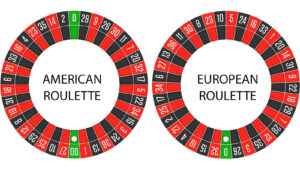
Core Differences Between European and American Roulette
The main differences between these two roulette versions come down to the number of zero pockets, house advantage percentages, and how the wheels are arranged. These changes affect player odds and betting strategies significantly.
Number of Zeros on the Wheel
European roulette features a single green zero pocket on its wheel. The wheel contains 37 total pockets numbered 0 through 36.
American roulette includes both a single zero (0) and a double zero (00) pocket. This creates 38 total pockets on the American wheel instead of 37.
The extra double zero pocket appears directly opposite the single zero on American wheels. Both zero pockets are colored green to distinguish them from the red and black numbered pockets.
This single additional pocket creates a chain reaction that affects every aspect of the game. Players face different odds on identical bets between the two versions.
House Edge and Player Odds
The extra zero in American roulette increases the house edge significantly. European roulette has a house edge of 2.7% on most bets.
American roulette carries a house edge of 5.26% due to the additional double zero pocket. This means players lose money faster on average when playing the American version.
European Roulette Odds:
- Single number bet: 2.7% house edge
- Even money bets: 2.7% house edge
- Column/dozen bets: 2.7% house edge
American Roulette Odds:
- Single number bet: 5.26% house edge
- Even money bets: 5.26% house edge
- Column/dozen bets: 5.26% house edge
The probability of winning specific bets also changes. A single number bet wins 1 in 37 spins in European roulette but only 1 in 38 spins in American roulette.
Wheel Layout Variations
European and American wheels arrange their numbers in completely different sequences. European wheels follow a specific clockwise pattern that alternates high and low numbers more evenly.
American wheels use a different number sequence that places the double zero directly across from the single zero. The number arrangement creates different neighbor betting opportunities.
European Wheel Sequence: 0-32-15-19-4-21-2-25-17-34-6-27-13-36-11-30-8-23-10-5-24-16-33-1-20-14-31-9-22-18-29-7-28-12-35-3-26
American Wheel Sequence: 0-28-9-26-30-11-7-20-32-17-5-22-34-15-3-24-36-13-1-00-27-10-25-29-12-8-19-31-18-6-21-33-16-4-23-35-14-2
The different layouts affect betting strategies that rely on wheel sections. Players who use neighbor bets or sector betting must adjust their approach between the two versions.
Table layouts also differ slightly, with American tables featuring the double zero betting area prominently displayed alongside the single zero.
Gameplay Rules and Table Layout
The physical setup and betting rules create the main differences between European and American roulette. European tables feature 37 numbered pockets with a single zero, while American tables have 38 pockets including both single and double zeros.
Betting Options and Types
Both versions offer identical betting categories with the same payout structures. Players can place inside bets on specific numbers or small groups of numbers.
Inside bets include:
- Straight up (single number): 35:1 payout
- Split (two adjacent numbers): 17:1 payout
- Street (three numbers in a row): 11:1 payout
- Corner (four numbers): 8:1 payout
Outside bets cover larger groups of numbers with lower payouts but higher winning chances. These include red/black, odd/even, high/low (all paying 1:1), dozens and columns (both paying 2:1).
European roulette includes special rules like “en prison” and “la partage” that provide players with a safety net for even-money bets when the ball lands on zero. These rules reduce losses on outside bets by either returning half the stake or allowing another spin.
Table Design and Markings
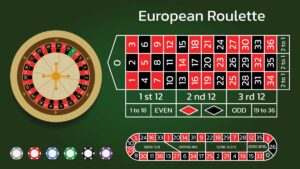
The number grid layout remains consistent between both versions. Players see numbers 1-36 arranged in three columns with alternating red and black colors.
The key difference appears in the zero sections. European tables display a single green zero at the top of the betting grid. American tables show both single zero (0) and double zero (00) positions.
Different table layouts affect the arrangement of outside betting areas. European tables often feature the racetrack oval for call bets. American tables typically use a more compact design without the racetrack section.
The wheel positioning varies by casino but doesn’t affect gameplay rules or betting options.
Winning Odds and Payouts
The main difference between European and American roulette lies in the odds, not the payouts. European roulette offers better winning chances due to having only one zero pocket, while American roulette has both zero and double zero pockets that reduce player odds.
Single Number Bets
Single number bets pay 35:1 in both European and American roulette. However, the odds of winning differ significantly between the two versions.
In European roulette, players have a 1 in 37 chance of hitting their number. This gives them 2.70% odds of winning on each spin.
American roulette players face 1 in 38 odds due to the extra double zero pocket. Their winning chances drop to 2.63% per spin.
The house edge also varies between versions. European roulette maintains a 2.70% house edge on single number bets. American roulette jumps to a 5.26% house edge because of the additional zero.
| Roulette Type | Odds | House Edge | Payout |
| European | 1 in 37 | 2.70% | 35:1 |
| American | 1 in 38 | 5.26% | 35:1 |
Even Money Bets
Even money bets include red/black, odd/even, and high/low wagers. These bets pay 1:1 in both roulette versions but offer different winning probabilities.
European roulette gives players 18 in 37 chances of winning even money bets. This equals 48.65% winning odds on each spin.
American roulette reduces the odds to 18 in 38 chances. Players get 47.37% winning probability due to the extra zero pocket.
The house edge remains consistent with single number bets. European roulette keeps a 2.70% house edge on even money bets. American roulette maintains its 5.26% house edge across all standard bets.
European Even Money Odds:
- Winning chances: 48.65%
- House edge: 2.70%
- Payout: 1:1
American Even Money Odds:
- Winning chances: 47.37%
- House edge: 5.26%
- Payout: 1:1
Side Bets Specific to American Roulette
American roulette offers unique betting options that European roulette does not have. The most common is the five-number bet or “basket bet.”
The five-number bet covers 0, 00, 1, 2, and 3. This bet pays 6:1 and gives players 5 in 38 chances of winning. The odds equal 13.16% probability per spin.
This bet carries the worst house edge in American roulette at 7.89%. Most experienced players avoid this wager due to its poor odds.
Some American roulette tables offer snake bets covering specific number patterns. These bets typically pay 2:1 and cover 12 numbers total.
Players can also find neighbor bets on certain American wheels. These wagers cover a number plus its adjacent pockets on the wheel layout.
The double zero pocket creates additional combination betting opportunities. Players can bet on 0-00 splits or include both zeros in corner bets with nearby numbers.
Strategy Differences for Players
European roulette offers better odds due to its single zero, while betting systems must account for the different house edges between versions.
Choosing the Right Version
European roulette provides better winning chances than American roulette. The single zero wheel gives the house a 2.7% edge. American roulette has both single and double zeros, creating a 5.26% house edge.
Smart players pick European roulette when available. The difference saves money over time. For every $100 wagered, players lose $2.70 less on European wheels compared to American ones.
European roulette’s better odds make it the clear choice for serious players. The lower house edge means bankrolls last longer. Players get more spins for their money.
New players should always look for European tables first. Even casual players benefit from the improved odds. The single zero makes every bet more favorable.
Adjustment of Betting Systems
Betting systems work differently on each roulette version. The Martingale system requires larger bankrolls on American wheels. The higher house edge eats into profits faster.
Progressive systems like D’Alembert need adjustment for American roulette. Players must expect more losses in shorter periods. The double zero creates additional losing outcomes.
European roulette benefits:
- Betting systems perform better
- Fewer losing numbers (37 vs 38)
- Longer playing sessions possible
American roulette’s increased house edge makes all betting systems less effective. Players using systems should stick to European wheels. The extra zero disrupts most mathematical progressions.
Conservative betting works best on American roulette. Players should use smaller bet sizes to account for the higher house edge.
Popularity and Geographic Distribution
European roulette dominates casinos across Europe, Asia, and most international markets due to its lower house edge. American roulette remains primarily popular in the United States and a few Caribbean destinations where it originated.
Prevalence in European Casinos
European casinos almost exclusively offer European roulette as their standard game. The single-zero wheel appears in 95% of European gaming establishments, from Monte Carlo’s prestigious Casino de Monaco to London’s modern betting halls.
Major European gambling destinations like Malta, Gibraltar, and the Isle of Man feature European roulette in their regulated online casinos. These jurisdictions serve millions of international players who prefer European roulette’s better odds.
Popular European casino locations:
- Monte Carlo, Monaco
- London, United Kingdom
- Malta gaming centers
- German state casinos
- Austrian casino resorts
Most European players consider American roulette unfavorable due to the additional double-zero pocket. This creates a cultural preference that reinforces European roulette’s dominance across the continent.
Prevalence in American Casinos
American casinos predominantly feature American roulette with its distinctive double-zero wheel. Las Vegas Strip casinos typically offer 80-90% American roulette tables, with European versions limited to high-roller areas.
Atlantic City, Reno, and regional American casinos follow similar patterns. The double-zero format generates higher profits for casino operators through its 5.26% house edge compared to European roulette’s 2.7%.
Key American roulette markets:
- Las Vegas, Nevada
- Atlantic City, New Jersey
- Reno and Lake Tahoe
- Tribal casinos nationwide
- Caribbean resort destinations
Some premium American casinos now offer European roulette options to attract experienced players. However, these tables often require higher minimum bets and occupy smaller floor space than their American counterparts.
Online Roulette: European vs. American
Most online casinos offer both European and American roulette variants with identical rules to their land-based counterparts. European roulette provides better odds for players due to its single zero wheel configuration.
Availability Across Online Platforms
Online casinos typically feature both European and American roulette versions on their platforms. European roulette appears more frequently across gaming sites due to player preference for better odds.
Common Platform Features:
- European roulette: Featured on 95% of online casinos
- American roulette: Available on 75% of platforms
- Mobile compatibility for both variants
- Multiple table limits ranging from $0.10 to $500 per spin
Many operators place European roulette tables more prominently in their lobby sections. American roulette often appears in separate sections or under “Vegas-style” game categories.
Some platforms offer enhanced versions with additional side bets or progressive jackpots. These modifications maintain the core wheel differences between variants.
Live Dealer Experiences
Live dealer roulette brings authentic casino atmosphere to online play. European wheels dominate live dealer offerings due to their lower house edge attracting more players.
Live Dealer Differences:
- European tables: 8-12 available per major casino
- American tables: 2-4 available per major casino
- Professional dealers from European gaming studios
- HD streaming with multiple camera angles
Live European roulette sessions typically host 200-300 players simultaneously. American roulette live tables usually accommodate 50-100 players per session.
Betting interfaces remain identical between variants in live dealer format. The physical wheel determines the mathematical differences, not the digital interface.
Historical Origins and Evolution
Roulette began in 18th-century France and spread across continents with key changes. The European version came first with a single zero, while American casinos later added a double zero to increase profits.
Development of the European Wheel
Roulette’s origins trace back to 18th-century France, where mathematician Blaise Pascal created the foundation while working on a perpetual motion machine. His invention became the basis for what would become European roulette.
The original French wheel featured numbers 1-36 plus a single zero. This design created 37 total slots on the European wheel, establishing the standard that remains today.
Key Features of Early European Roulette:
- Single zero (0) pocket
- Numbers 1-36 in red and black
- House edge of 2.7%
European roulette emerged first in casino gaming, spreading throughout European gambling houses during the 18th and 19th centuries. The single zero design provided players with better odds compared to what would later develop in America.
Emergence of the American Double Zero
When roulette traveled from Europe to America, casino operators made a crucial change. They added a second zero pocket to increase the house advantage and boost profits.
American roulette features 38 slots total, including numbers 1-36, a single zero, and a double zero (00). This extra pocket significantly changed the game’s mathematics.
The double zero addition increased the house edge to 5.26% in American roulette. This nearly doubled the casino’s advantage compared to the European version.
Impact of the Double Zero:
- Reduced player winning odds
- Increased casino profits
- Created distinct American roulette identity
American roulette became more prevalent in United States casinos, while European casinos maintained the original single zero format. This geographical split continues today in most gambling destinations worldwide.

Frequently Asked Questions
European roulette provides better odds with a 2.7% house edge compared to American roulette’s 5.26% house edge. The key differences lie in wheel design, table layouts, and specific rule variations that affect player outcomes.
Why does European Roulette offer better odds than American Roulette?
European roulette offers better odds because it has only one zero pocket instead of two. American roulette contains both a single zero (0) and double zero (00) pocket.
The single zero in European roulette creates a house edge of 2.7%. American roulette’s double zero increases the house edge to 5.26%.
This means players lose money more slowly when playing European roulette. The extra zero pocket in American roulette nearly doubles the casino’s advantage.
What are the main differences between the American and French Roulette versions?
French roulette uses the same single-zero wheel as European roulette but includes special rules. The “La Partage” rule returns half of even-money bets when the ball lands on zero.
The “En Prison” rule allows players to leave even-money bets for the next spin when zero hits. These rules reduce the house edge to just 1.35% on even-money bets.
French roulette tables often display French terms for bets. The wheel layout remains identical to European roulette with 37 pockets total.
Can you explain the difference in the layout of European versus American Roulette tables?
European roulette wheels have 37 pockets numbered 0-36. American roulette wheels contain 38 pockets with numbers 0, 00, and 1-36.
The betting layout on European tables shows a single zero at the top. American tables display both 0 and 00 at the top of the betting grid.
Both versions use the same color scheme with red and black numbers. The zero pockets appear in green on both wheel types.
What is the statistical advantage of playing European Roulette over American Roulette?
Players face nearly half the house edge when choosing European over American roulette. The 2.7% house edge means players lose $2.70 for every $100 wagered over time.
American roulette’s 5.26% house edge costs players $5.26 per $100 wagered. This represents a 94% increase in expected losses.
The single zero provides better odds for all bet types. Even-money bets have a 48.65% chance of winning in European roulette versus 47.37% in American roulette.
Which roulette strategies are most effective when playing European Roulette?
The Martingale system works better on European roulette due to lower house edge. Players double their bet after each loss and return to the original amount after wins.
The D’Alembert strategy increases bets by one unit after losses and decreases by one unit after wins. This approach creates smaller swings than the Martingale system.
Even-money bets like red/black or odd/even provide the best odds in European roulette. These bets offer nearly 50% winning probability with 1:1 payouts.
Are the payouts different in European Roulette compared to American Roulette?
Both roulette versions use identical payout structures for all bet types. Straight-up bets pay 35:1, split bets pay 17:1, and even-money bets pay 1:1.
The difference lies in winning probability, not payout amounts. European roulette provides better chances of winning due to fewer total pockets.
A straight-up bet has a 2.70% chance of winning in European roulette versus 2.63% in American roulette. The extra zero pocket reduces all winning probabilities in American roulette.